


- LASER CLEANING

6-in-1 Laser Cleaner
Pulsed Luggage Laser Cleaner
Continuous Mini Rust Remover
Pulsed Mini Laser Cleaner
Continuous Laser Rust Remover Pulsed & Continuous Hybrid Laser Cleaner
High Power Continuous Laser Rust Remover
High Power Pulsed Laser Cleaner
Automatic Pipe Laser Cleaner Automatic Online Mold Laser Cleaner Desktop & Handheld in One Laser Cleaner - LASER WELDING
Air Cooled Luggage Laser Welder
Water Cooled Mini Laser Welder
High Power Water Cooled Laser Welder
Mini Jewelry Laser Welder
High Power Jewelry Laser Welder
Handheld & Cobot In One Laser Welder
Mold Repair Laser Welder
Robotic Automated Laser Welder
Automated Laser Welder Plastic Laser Welder
Automated Galvo Laser Welder - LASER MARKING
All-in-One-LITE
All-in-One-PRO
All-in-One-INLINE
All-in-One-FLY All-in-One-MAX All-in-One-VISION All-in-One-Array
28W+20W Dual Laser
Inline Laser Marker & Engraver
Fly Laser Marker & Coder
Desktop Laser Marker & Engraver
Table Laser Marker & Engraver
Mini Laser Marker & Engraver
Class 1 Laser Marker & Engraver
Handheld Laser Marker & Engraver Mini Class 1 Laser Marker & Engraver
3D Laser Marker & Engraver
Color Laser Marker & Engraver Ultra Size Laser Marker & Engraver - METAL CUTTING
Open Type Laser Cutter
Full Cover Laser Cutter
Small Precision Laser Cutter
Tube Laser Cutter
Sheet & Tube in One Laser Cutter
Automatic Coil Fed Laser Cutter
Ultra Format Laser Cutter with Rail
Glass Laser Cutter - LASER ENGRAVING
All-in-One-LITE
All-in-One-PRO
All-in-One-INLINE
All-in-One-FLY All-in-One-MAX All-in-One-VISION All-in-One-Array
28W+20W Dual Laser
Inline Laser Marker & Engraver
Fly Laser Marker & Coder
Desktop Laser Marker & Engraver
Table Laser Marker & Engraver
Mini Laser Marker & Engraver
Class 1 Laser Marker & Engraver
Handheld Laser Marker & Engraver Mini Class 1 Laser Marker & Engraver
3D Laser Marker & Engraver
Color Laser Marker & Engraver Ultra Size Laser Marker & Engraver - 3D PRINTING
SLM Metal 3D Printer
SLS Nylon 3D Printer
SLA Resin 3D Printer


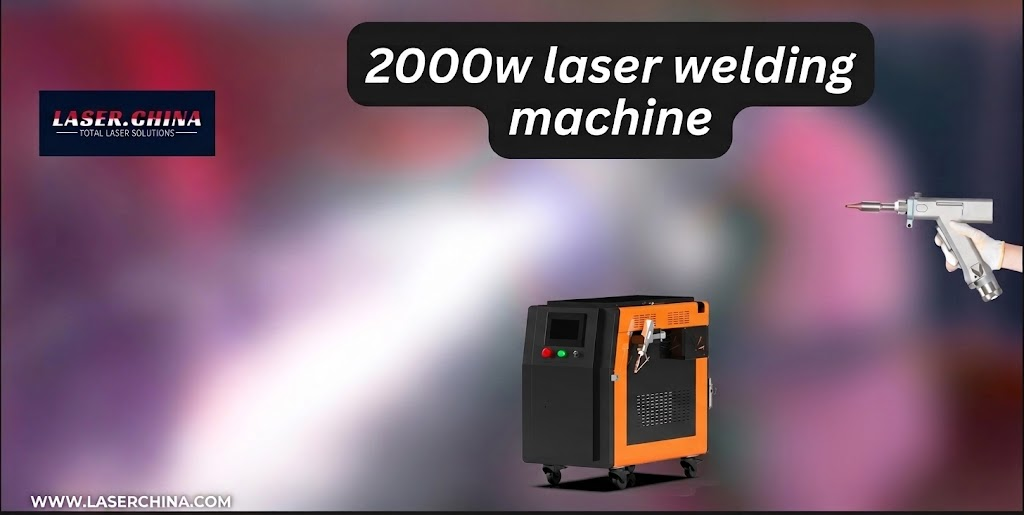
Welding has quietly gone through a revolution, and most workshops are still catching up. The Advanced 2000W Laser Welding Machine is at the center of that shift — delivering deeper penetration, cleaner seams, and speeds that make traditional TIG and MIG setups feel like relics. If you’re fabricating stainless steel kitchen equipment, aluminum enclosures, carbon steel frames, or precision medical components, a 2000W laser welding machine cuts your cycle times dramatically while slashing the grinding and polishing that eats your labor budget.
At LaserChina, we’ve spent years engineering handheld and automated fiber laser welding systems built for real production floors — not showroom demos. Our 2000W models pair proven fiber sources with intuitive wobble welding heads, giving operators professional-grade results within days, not months. This guide covers everything: how the technology works, what it welds, real cost breakdowns, safety essentials, and the buying mistakes that quietly drain thousands from your budget.
What Is an Advanced 2000W Laser Welding Machine?
A 2000W laser welding machine uses a fiber laser source to generate a highly concentrated beam of infrared light, focused through a collimator and delivered via a flexible armored fiber cable to a welding head. That beam melts the base metal in a tightly controlled zone, fusing two parts together with minimal heat spread. The “2000W” refers to the rated output power of the laser source — the sweet spot between affordability and industrial capability. Unlike arc welding, there’s no electrode, no filler dependency for most joints, and no spatter storm to clean up. The result is a narrow, deep, cosmetically clean weld bead that often needs zero post-processing.
How Does Fiber Laser Welding Actually Work?
The process starts with a fiber laser generator — typically Raycus, MAX, or IPG — that pumps light through a doped optical fiber, amplifying it into a coherent 1080nm beam. That beam travels through the delivery fiber into the welding head, where a collimating lens and focusing lens concentrate it onto a spot as small as 0.2mm. At 2000W, the energy density at that spot is enormous, instantly vaporizing a thin channel in the metal — this is called keyhole welding mode. Molten material flows around the keyhole and solidifies behind it as the head moves. Shielding gas (argon or nitrogen) flows continuously to prevent oxidation and protect the optics.

Why 2000W? The Power Sweet Spot Explained
Power selection is where most buyers get it wrong — either overspending on capacity they’ll never use or underbuying and hitting a wall within a year. A 1000W or 1500W machine handles thin sheet work fine but struggles past 4mm on stainless and stalls badly on aluminum, which reflects and conducts heat aggressively. A 3000W system costs significantly more, demands heavier chillers, and often requires three-phase power upgrades. The 2000W laser welding machine sits precisely at the point where you can weld 0.5mm foil and 5mm plate on the same shift, handle reflective metals confidently, and still run on manageable electrical infrastructure. For 80% of job shops, it’s the machine that never becomes the bottleneck.
Materials It Welds: A Complete Compatibility Breakdown
Stainless steel is where laser welding shines brightest — 304, 316, and 201 grades produce mirror-clean seams that often need only a light pass with a scotch pad. Carbon steel welds beautifully up to 5mm with proper parameter tuning, ideal for structural brackets, frames, and enclosures. Aluminum (5052, 6061) is fully weldable at 2000W thanks to the high energy density overcoming its reflectivity and thermal conductivity, though it demands wobble welding and precise gas coverage. Galvanized steel works with slight gap allowance to let zinc vapor escape. Brass, copper, titanium, and dissimilar metal joints (steel-to-stainless) are also achievable — combinations that are difficult or impossible with conventional arc processes.
Thickness Capacity: Realistic Numbers, Not Marketing Hype
Here’s the honest data most sellers won’t print. On stainless steel, a 2000W machine performs single-pass butt welds up to 5mm reliably, with 4mm being the comfortable production zone. Carbon steel matches that range closely, sometimes reaching 6mm with slower travel speeds and beveled prep. Aluminum realistically tops out around 4mm for structural-quality welds, since it absorbs less of the beam. Thin materials from 0.3mm upward are where the machine truly dominates — heat input is so controlled that warping practically disappears. Always remember: quoted maximums assume perfect fit-up, clean surfaces, and optimal gas flow. Real-world production should sit 20% below the stated ceiling.
Handheld vs. Automated: Which Configuration Wins?
Handheld 2000W systems dominate the market because of sheer flexibility — the operator carries a lightweight gun on a 10–15 meter fiber, reaching into corners, awkward assemblies, and oversized workpieces that no fixture could hold. They’re perfect for fabrication shops, railings, tanks, cabinets, and repair work with mixed-batch production. Automated configurations mount the welding head on a gantry, robotic arm, or rotary positioner, delivering repeatable precision for high-volume identical parts. Many shops start handheld and add automation later. LaserChina supplies both architectures using the same laser source platform, so upgrading doesn’t mean replacing your core investment.
The Wobble Welding Advantage Nobody Explains Properly
Standard laser welding produces an extremely narrow bead — excellent for penetration, but unforgiving when your parts have gaps or slight misalignment. Wobble welding solves this by oscillating the beam in a controlled pattern (circular, figure-eight, linear, or spiral) at high frequency as the head travels. This widens the effective weld zone, bridges gaps up to 1mm, and dramatically improves tolerance to imperfect fit-up. It also produces the attractive stacked-dime appearance customers associate with premium craftsmanship. Adjustable wobble width and speed let operators tune the bead visually — a feature that turns average welders into high-output professionals in a matter of days.
Speed and Productivity: The Numbers That Change Your Business
Speed is where the return on investment becomes undeniable. Laser welding typically runs 2 to 5 times faster than TIG on comparable joints — a seam that takes four minutes with TIG often completes in under one. But the bigger savings hide downstream: because there’s minimal spatter, no slag, and very little discoloration, the grinding and polishing stage shrinks by 60–80%. On a stainless steel cabinet that previously required 40 minutes of finishing, you might now spend eight. Multiply that across a week and you’ve effectively added a worker to your payroll without adding a salary.
Operating Costs: What You’ll Actually Spend Monthly
A 2000W fiber laser welding machine draws roughly 6–8kW under active load, including the chiller — modest compared to the productivity gained. Consumables are refreshingly minimal: protective lens covers (a few dollars each, replaced periodically), shielding gas, and welding wire only when filling gaps or building up material. Fiber laser sources carry rated lifespans around 100,000 hours, meaning the expensive core component outlives most businesses’ planning horizons. There are no electrodes, no tips, no nozzles burning out weekly. Compared with TIG, the recurring consumable spend typically drops by a substantial margin, making the total cost of ownership genuinely attractive.
Safety Requirements You Absolutely Cannot Skip
Fiber lasers operate at 1080nm — invisible to the human eye, which makes them uniquely dangerous. Certified laser safety goggles rated specifically for 1064–1080nm wavelength are non-negotiable for every person in the work area, not just the operator. Set up matte, non-reflective barriers around the welding zone to contain stray reflections, and never weld near polished mirrors or uncoated metal surfaces at beam height. Proper fume extraction matters because vaporized metal generates fine particulates. Quality machines include safety interlocks that disable firing unless the nozzle contacts the workpiece — insist on this feature and never bypass it.
Cleaning, Cutting, and Welding: The 3-in-1 Machines
Many modern 2000W systems ship as multifunction platforms — weld, cut, and clean from one laser source by swapping heads or modes. The cleaning function removes rust, paint, oxide layers, and oil residue before welding, dramatically improving joint quality on reclaimed or weathered material. Cutting mode handles thin sheet trimming and hole work up to roughly 3mm, useful for adjustments without walking to another machine. For workshops with limited floor space and mixed workloads, this consolidation is transformative. LaserChina’s multifunction 2000W units are engineered so mode switching takes minutes, not hours of recalibration.
Buying Guide: How to Choose Without Getting Burned
Start by verifying the laser source brand and model number in writing — Raycus, MAX, and IPG are the established names, and vague “imported fiber source” claims are a warning sign. Confirm the chiller capacity matches the source rating, since undersized cooling causes thermal throttling and shortens component life. Ask specifically about warranty terms on the laser source versus the cabinet, as these often differ. Request sample welds on your actual material and thickness before committing. Finally, evaluate after-sales support realistically: spare optics availability, remote diagnostic capability, and operator training all determine whether your machine runs or sits idle.
Common Mistakes That Ruin Weld Quality
The number one failure is poor fit-up — lasers concentrate energy in a tiny spot, so a 2mm gap means the beam passes through empty air instead of fusing metal. Second is neglected protective lenses; a spatter-fogged lens absorbs energy, overheats, and can damage the collimator behind it. Third is inadequate or misdirected shielding gas, which produces oxidized, porous, discolored welds that look burnt. Fourth is running excessive power on thin material out of impatience, causing burn-through. Fifth is skipping surface preparation — oil, paint, and heavy rust contaminate the weld pool and create inclusions that fail under stress.
Maintenance Routine That Keeps Output Consistent
Consistent weld quality comes from a short, disciplined maintenance habit rather than occasional deep servicing. Inspect the protective lens cover before each shift and replace it the moment spatter or fogging appears — it costs a few dollars and protects far more expensive optics behind it. Keep the chiller topped with distilled or deionized water and change it on schedule to prevent scaling inside the cooling channels. Clear spatter from the nozzle regularly, check the fiber cable for tight bends or crush points along its route, and test gas lines for leaks. The entire routine takes under fifteen minutes per week.
Why Choose LaserChina for Your 2000W Investment
LaserChina builds laser systems for operators who measure success in parts shipped, not spec sheets read. Every 2000W welding machine we deliver uses verified-brand fiber sources, properly matched chillers, and welding heads with genuine wobble control and adjustable spot parameters. We provide parameter libraries tuned for common materials so your team isn’t guessing on day one, plus responsive technical support that answers in hours. Our machines are tested under load before shipment, and we back them with transparent warranty terms. Whether you’re a growing fabrication shop or scaling a production line, we build the machine around your workload.
Final Thoughts
The Advanced 2000W Laser Welding Machine isn’t a luxury upgrade anymore — it’s becoming the baseline for shops that intend to stay competitive on price, lead time, and finish quality. The 2000W class earns its popularity honestly: enough power to handle 5mm stainless, reflective aluminum, and dissimilar metal joints, without the infrastructure demands and capital cost of higher-wattage systems. What actually transforms a business, though, isn’t the wattage on the label. It’s the collapse of post-weld finishing time, the shorter operator learning curve, and the consumable bill that stops bleeding every month.
Before you buy, do the unglamorous work: verify the fiber source brand in writing, confirm the chiller is properly matched, demand sample welds on your own material, and pin down warranty and support terms. Machines that sit idle waiting for a replacement lens or a technician who never calls back are expensive regardless of purchase price.
LaserChina builds and supports 2000W welding systems for exactly this reality — verified components, tested performance, tuned parameter libraries, and support that answers. Reach out with your material types and thickness range, and we’ll recommend the configuration that fits your floor rather than the one that fits our inventory.


